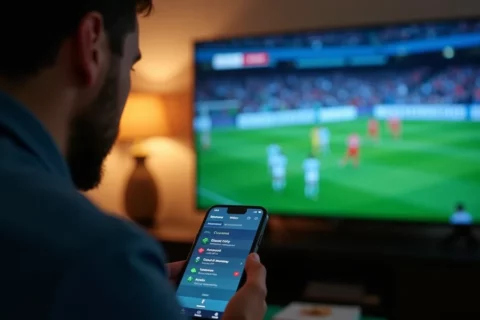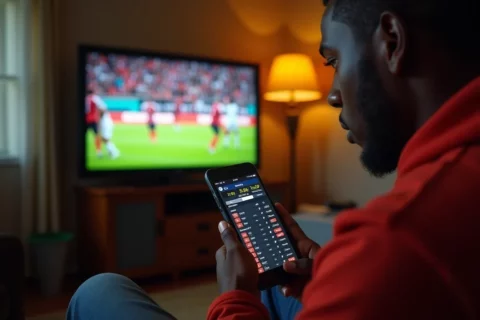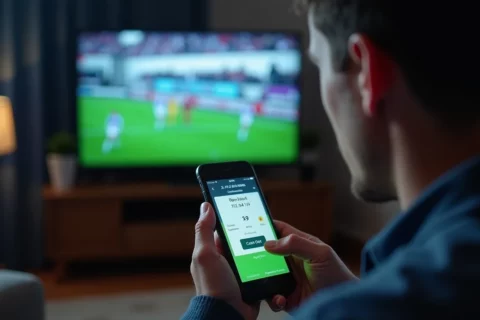

You press confirm on a live bet the second you see the striker break through the defence, and the app throws back a message saying the odds have changed. The goal has not even hit your screen yet. Somewhere in a data centre, a machine decided the price three seconds ago. That gap between what you see and what the bookmaker already knows is the entire architecture of in-play betting.
The Feed You Cannot See
Bookmakers do not watch the same match you do. While you are looking at a DStv broadcast or a buffered stream on your phone, their systems are fed by official data providers like Sportradar, Genius Sports, and IMG Arena, who hold exclusive rights to collect information straight from the venue. These feeds carry latency measured in milliseconds, not seconds. Your stream might lag twenty, thirty, even sixty seconds behind the action. The bookmaker’s pricing engine has already registered the shot on target, the corner, the substitution, before the player has finished celebrating.
For events without digital infrastructure, scouts sit in the stands with low-latency terminals, punching in data faster than any camera can broadcast it. The granularity is exhaustive. Algorithms track hundreds of points per second, from ball trajectory to foul counts to player positioning. All of it feeds into machine-learning models that compare live events against pre-match probability curves. The infrastructure sits on dedicated fibre networks, server farms co-located at internet exchange points. Every decision is optimised for speed. Hollywoodbets, Betway SA, and every other provincially-licensed operator in this country plug into these same global systems. The National Gambling Act 7 of 2004 sets the rules for who can offer online sports betting, but it does not slow the machinery down.
The Delay That Eats Your Edge
Television broadcasts, even satellite, typically run five to ten seconds behind live action. Streaming services are worse. DStv Now, Showmax, YouTube TV, and the rest buffer and encode their way into delays of twenty to thirty seconds, sometimes more. That is an eternity in pricing terms.
Consider what happens when a goal goes in. The bookmaker’s automated system receives the data within half a second to two seconds. It suspends the match-winner market, recalculates probability, adjusts the over/under total, and reprices next goalscorer. All of it is done before the ball is back at the centre circle. A bettor watching on a thirty-second lag sees the same goal half a minute later, reaches for their phone, and tries to place a bet at 2.00 on the team that just scored. The app offers 1.30, or rejects the bet entirely, or shows the market suspended. The “odds changed” message is the system being honest about a price that died before you knew the game had moved.
Human reaction time sits at roughly two hundred to three hundred milliseconds. Bookmaker algorithms react in single-digit milliseconds and process thousands of data points simultaneously. You are slower by an order of magnitude that makes competition impossible.
How the Machines Protect the House
Automated pricing moves fast and manages risk in real time. Dynamic algorithms constantly recalculate win probability using expected goals models, historical trend databases, and current liability exposure across the bookmaker’s entire position. If too much money piles onto one outcome, the system tightens those odds and lengthens the others, balancing the book without human intervention.
Market suspensions act as circuit breakers. A goal, a red card, a penalty award, a serious injury, any predefined trigger freezes betting instantly. The model re-evaluates during the pause. When the market reopens, the price reflects a reality you have only just witnessed. Professional bettors who might exploit price discrepancies between operators find those windows slammed shut before they can act.
The South African regulators require fair play and risk management systems from licensed operators. The automated tools satisfy that mandate while ensuring that when information asymmetry appears, it resolves in the house’s favour every time.
What the Numbers Actually Look Like
The speed of these shifts is not theoretical. In a football match where Team A opens at 1.80 to win and Team B at 4.00, a goal for the underdog flips those numbers instantly. Team A might jump to 3.50, Team B collapse to 2.00, and the total goals market reprices before the scorer has finished his run. A red card at 0-0 can triple the affected team’s odds, from 2.00 to 6.00, while the opposition shortens from 3.00 to 1.50, all within the two seconds it takes the referee to reach for his pocket.
Tennis moves just as brutally. A break point in a tight match can shift game-winning odds from 1.50 to 3.00 during a single rally. Rugby tries halve underdog prices in moments. An eight-point basketball run moves the live spread several points and the moneyline substantially within sixty seconds. Cricket wickets in T20 cricket can send a batting team’s price from 1.60 to 2.50 and crash the total runs market simultaneously.
Every one of these shifts has already happened before your screen shows you why.
The Illusion You Are Actually Playing
The most persistent myth in live betting is that watching the game gives you an edge. You see possession shifting, a player limping, momentum building, and you believe your eyes grant you superior information. They grant you delayed information, processed through emotion, and acted upon through fingers that move at human speed.
Bettors routinely assume they compete against other viewers, other punters reacting to the same pictures. Their opponent is a pricing system engineered to outpace human cognition. The intuition that tells you a team looks dangerous, the pattern recognition that says this striker is finding space, the gut feeling that a comeback is brewing, none of it operates faster than a model that has already priced the probability of every possible next event.
“My human intuition is superior” is a comforting thought. It is also wrong in ways that cost money. The bookmaker does not need to predict the future perfectly. The bookmaker only needs to predict it faster than you, and that threshold was passed years ago.
What This Means for How You Actually Bet
None of this makes live betting unplayable. It makes it playable only with clear eyes about what you are actually doing. You are not exploiting information. You are accepting a price set by someone who knew the score before you did, and who has already adjusted for what you think you have just figured out.
The honest approach is to treat live betting as entertainment with a cost, not as a skill edge waiting to be seized. If you enjoy the friction of having money on a match while you watch it, that is a legitimate reason to play. But the framing matters. You are paying for the sensation of participation, not purchasing an information advantage that does not exist.
The corner betting shops of the eighties and nineties had their own asymmetries, but they moved at human speed. A punter could watch the same race, hear the same commentary, and have a fair shake at judging a horse’s condition against the bookie’s eye. The modern in-play market has abolished that parity. The screen in your hand shows a match that has already moved on, priced by machines you will never outrun, and the “odds changed” message is the only honest thing in the exchange.