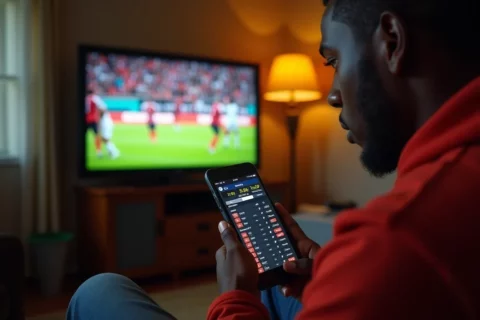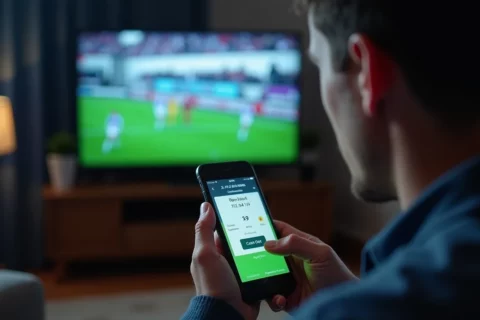

The cash-out button flashes green on your phone and your stomach flips. R6,000 on the table when you staked R100. Nine legs of your Saturday accumulator have already come home. One remains: Kaizer Chiefs away to Golden Arrows, and Chiefs are up 1-0 at halftime. The bookie is offering you sixty times your money right now, guaranteed, no matter what happens in the second forty-five. Most punters look at that R6,000, look at their R100 stake, and feel like the house is doing them a favour. The house is not doing them a favour. They are being offered a fresh bet at a fresh price, and the house edge is baked into it like it is baked into everything else.
What the Button Actually Sells You
A cash-out offer is a quoted settlement price, not a refund of your stake. The bookmaker is not saying sorry, here’s your money back, try again. They are naming a price at which they will buy your position off you, right now, before the event finishes. That position has a current market value based on live odds, your original stake, and what you stand to win. The bookmaker’s offer will always sit below that true value. How far below depends on their margin, their risk exposure on that particular market, and how badly they want you off their books.
When you placed that R100 accumulator, you accepted odds that already included the bookmaker’s overround. Every leg was priced slightly worse than the true probability. Now, with one leg running, the bookmaker calculates what your bet is worth at current live odds, applies their margin again, and offers you the result. You are not unwinding the original transaction. You are entering a new one, selling an asset at a price the buyer sets. The buyer is a bookmaker. Their entire business is buying low and selling high.
The legal framing in South Africa makes this clear. Provincial-licensed bookmakers operate under the National Gambling Act 7 of 2004, and cash-out is a feature embedded in their terms of service, not a regulatory obligation. If a match is abandoned for more than 48 hours, you get a void and a refund. That is a return to neutral. Cash-out is a contract for a new settlement. This distinction means you should know who is making the offer and why.
The Maths Your Phone Does Not Show
You need three numbers to evaluate what is really on the table: your original stake, your potential full payout, and the current live odds of whatever remains.
Take that R100 ten-leg accumulator with a potential R10,000 return. Nine legs have won. Chiefs are 1-0 up away, and their live odds to win are now roughly 1.40, down from maybe 2.20 at kickoff. The current live odds imply about a 71% chance of Chiefs holding on. Your bet’s raw current value is approximately R7,100 (R100 multiplied by the accumulated odds of your nine won legs multiplied by Chiefs’ current 1.40). The bookmaker offers R6,000. The gap, roughly R1,100 or 15%, is their margin and risk premium. They will pay you R6,000 now to avoid paying R10,000 later, and they have priced that privilege so they profit either way.
Most punters do not do this calculation. They compare the R6,000 to their R100 stake and feel brilliant. Or they compare it to the R10,000 they might still win and feel greedy. Both comparisons miss the point. The only relevant comparison is between the cash-out offer and the approximate current value of the bet based on live market odds. If you do not know that number, you are flying blind.
Recording market odds whenever a cash-out figure appears is the single most useful habit you can build. Screenshot the live odds of your remaining legs. Note the time. You will not out-calculate the bookmaker’s algorithms, which ingest real-time data and player behaviour across thousands of bets. But you can know whether you are being offered 70 cents on the dollar or 90 cents. That difference compounds across a lifetime of betting.
When Taking the Money Makes Sense Anyway
Cash-out is not always a mug’s game. There are moments when accepting a below-fair offer is the correct strategic play, and they have nothing to do with whether the number feels generous.
New information arrives. Chiefs’ goalkeeper goes down holding his hamstring in the 52nd minute. The substitute keeper is nineteen years old and has forty minutes of first-team football. The live odds do not instantly reflect what you have just seen, or they reflect it slower than your eyes do. The cash-out offer still sits at R6,000 for thirty seconds while the algorithms catch up. That is a genuine edge, and it belongs to you, not the house. Take it.
Bankroll pressure is real. You have R200 left in your account, rent is Tuesday, and this R6,000 represents a material change in your month. The expected value purists will sneer. They do not live your budget. Securing a profit that matters to your actual life is not irrational; it is rational with different inputs than pure EV. The mistake is pretending the offer is fair value when it is not. Be honest about the trade-off.
Hedging is the alternative the bookmaker hopes you forget about. Instead of accepting their R6,000, you could lay Chiefs on an exchange or bet Arrows and the draw with another bookmaker. The arithmetic is fiddly and requires liquidity you may not have, but it often yields better than the cash-out price. The bookmaker’s cash-out button is convenient. Convenience is a product they sell, and it is priced accordingly.
How the House Prices Its Buy-Back
Bookmakers do not pluck cash-out offers from the air. Their algorithms weigh live market odds, the original stake and potential payout, their overround on each leg, their total liability on that market, and time remaining. A red card in the 70th minute, a penalty awarded, a sudden injury to a key forward: these events trigger recalculations that can swing the offer by thousands of rand in seconds.
The overround is the hidden tax. If true probability says an event should price at 2.00, the bookmaker offers 1.85 or 1.90. That gap is their margin. In cash-out, the same principle applies to the live odds used in the calculation. The bookmaker’s internal odds are never the true market odds. They are the true market odds minus the house edge. Then, on top of that, risk management adjusts. If the bookmaker is heavily exposed on your particular accumulator outcome, they may nudge the offer up to encourage settlement. If they are comfortable, they nudge it down. You are not seeing a transparent price. You are seeing a price optimised for their profit and their exposure.
Competition between licensed South African bookmakers keeps this from being outright theft. One operator offers R6,000, another might offer R6,400 on the same position. The variance is real and worth shopping for. But no operator offers the full R7,100 raw value. That would be a charity, and these are businesses regulated by provincial boards, not charities.
The Habit That Changes Everything
The punter who treats cash-out as a refund button is the punter the industry loves. They see green, they feel relief, they click. The punter who treats it as a fresh bet at a quoted price starts asking different questions. What are the live odds right now? What is the implied probability? What is the gap between that and the offer? Is there new information the algorithms have not fully priced? Can I hedge this cheaper elsewhere?
This is not about becoming a trader. It is about understanding the mechanism you are using. The bookmaker has built an entire infrastructure to make cash-out feel like a gift. The green button, the flashing number, the countdown timer urging quick action. These are design choices, same as the near-miss symbols on a slot reel. They work because they trigger emotional responses that override calculation.
Your defence is a single habit: record the live odds when the cash-out appears. Do the rough multiplication. Know what your bet is worth before the bookmaker names their price. You will still sometimes take the money. The difference is you will know what you are selling and what you are paying for the sale. That knowledge does not guarantee profit. Nothing in gambling does. But it guarantees you are making a decision rather than reacting to a colour on a screen.