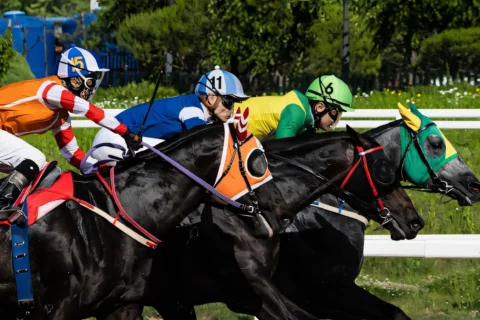

The man at the counter asked for “fifty each way on number seven” and slid two twenties and a ten across the Formica. When the clerk handed back the slip, the punter stared at the total stake printed in block capitals: R100. He had not misheard, but he had misunderstood what he was buying.
An each-way bet is sold as a single transaction, but the slip shows two separate wagers on that one line. The first says your horse wins outright. The second says it finishes close enough to matter, within the place terms the bookie set for that race. Each demands its own stake. “R50 each way” means R50 on the win and another R50 on the place. This is not cautious; you are doubling your exposure and calling it insurance.
How the place fraction cuts your odds
The place half does not ride at the same price as the win. It settles at a fraction of those odds, usually one-quarter or one-fifth, set by the number of runners and whether the race carries handicap weights. A 20/1 shot with quarter-place terms becomes 5/1 for the place portion. The bookie does not hide this. Licensed operators in this market, from the big online names down to the provincial shops, print the fraction and the qualifying positions right beside the main odds. The National Gambling Act requires that transparency. The information is available, but many bettors do not read it.
That fraction determines whether the each-way proposition succeeds or fails. At 20/1 with a quarter, your place return on a R50 stake is R250 plus your stake back. Your total outlay was R100. The place half alone turns a small profit if the horse runs second or third. At shorter prices, say 4/1 with a fifth, the place odds collapse to 4/5. A R50 place bet returns R90. You are down R10 on the whole wager despite collecting. The “safety net” has holes in it.
What actually happens at settlement
The two halves settle independently. Your horse finishes second. The win portion loses completely. The place portion wins at the reduced odds and pays whatever the fraction dictates. There is no consolation prize or partial credit on the win side. Two bets, two results. The punter who thought he had “covered himself” discovers he has simply placed a second bet with worse terms than the first.
Betting-shop confusion breeds its own folklore. I have watched a man argue for ten minutes that his each-way second-place finisher should pay “half the win” rather than the place fraction. He had conflated the two wagers into one continuous spectrum of success. The clerk did not budge. The rules are printed on the back of every slip and have not changed since the days when these shops smelled of cigarette smoke and took your coins in metal trays.
When the structure actually helps
Each-way betting is not a trap; it is a tool with specific uses. Large fields at Kenilworth or Turffontein, ten or more runners where the place terms extend to third or fourth, create situations where a longshot has genuine place form without the class to win. A 16/1 horse with a quarter place, in a race paying four places, offers a place return of 4/1. The maths can work. The strategy fails when applied to short-priced favourites in small fields, where the place fraction mangles already thin returns and the second stake buys almost nothing.
The discipline is in separating the two wagers mentally before you place them. Would you put R50 on this horse to win at these odds? Would you separately put R50 on it to place at the reduced fraction? If either answer is no, the each-way is not a compromise. It is two bad bets dressed as one.
The man at the counter eventually paid his R100 and kept the slip. He did not look convinced, but he did look at the printout longer than most. Reading the printout is the only habit that saves you in this game. The machine will not correct your misunderstanding. It will just take the money twice and explain once, in small print, when it is already too late.