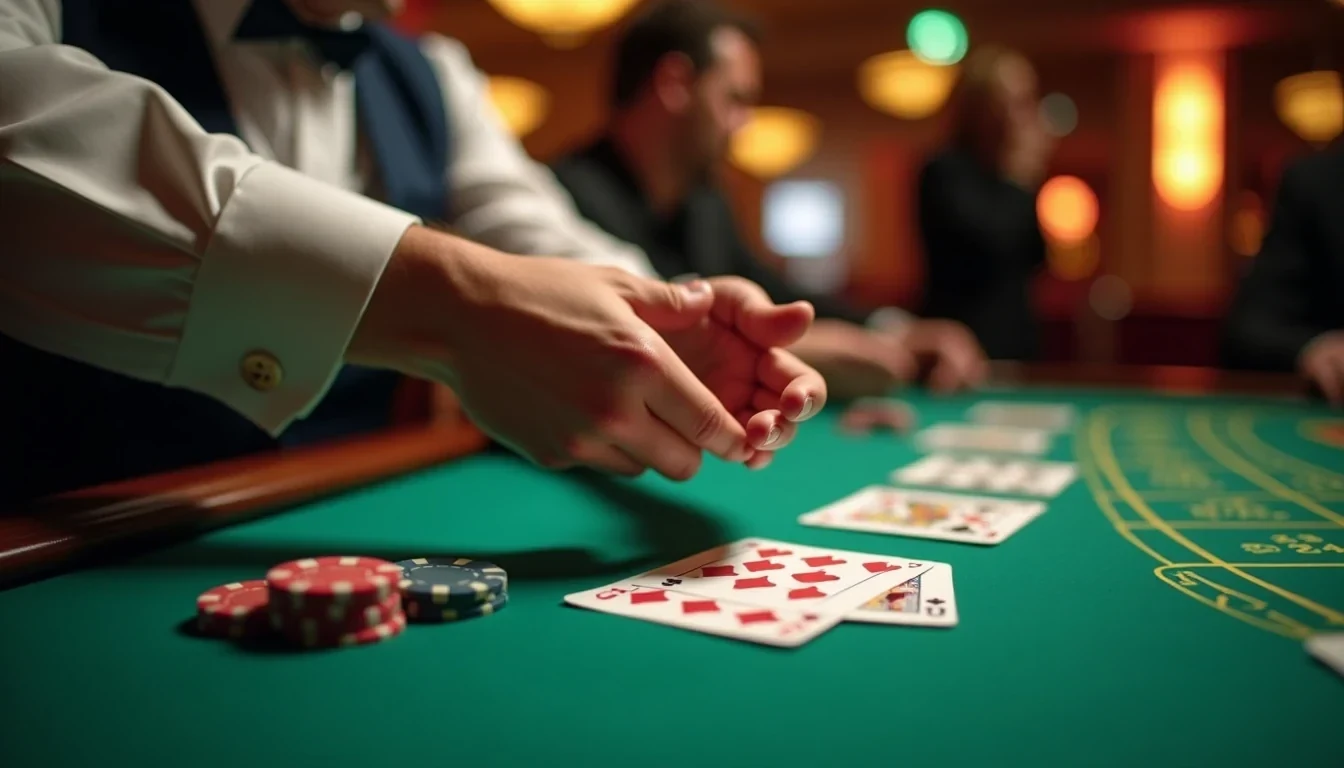
You can memorise every cell on a basic strategy chart and still bleed money at a blackjack table. The maths is not where most players lose. They lose in the gap between knowing that a hard 16 against a dealer’s 10 is a hit, and actually hitting it when the last three hands have already cost them two hundred rand.
The chart is not the hard part
Basic strategy is a solved problem. Computer simulations running millions of hands have mapped the optimal play for every combination of player cards and dealer upcard: hit or stand, double or don’t, split or keep the pair together. In a standard six-deck game where the dealer stands on soft 17 and you can double after splitting, perfect basic strategy trims the house edge to roughly half a percent. That is remarkably thin, and it is remarkably fragile.
The fragility comes from what the chart cannot do. It does not know that you just watched a dealer pull a five-card 21 from nowhere. It does not feel the weight of a losing streak. It does not hear the man two seats down muttering that you “took the dealer’s bust card.” The chart is pure probability, and probability is coldly indifferent to whether you need this hand to break even for the night.
When recent hands colonise the present one
The gambler’s fallacy is the obvious culprit here, though most players who fall for it would not name it that. They simply feel the pattern. The dealer has won five straight hands, so the shoe must be due to turn. They stand on a hard 15 against a 7, hoping the dealer finally breaks, or they hit a 12 against a 4 because “low cards are running.” Each hand in blackjack is statistically independent. The cards have no memory, but the player does, and that memory becomes a liability.
Loss aversion twists the knife. Kahneman and Tversky’s old finding holds at the felt table: losses sting about twice as hard as equivalent wins satisfy. A player down four hundred rand feels compelled to recover, which means doubling down on borderline hands that basic strategy says to hit or stand, or refusing to split 8s against a 10 because the doubled exposure feels too painful. The strategy demands aggression at precisely the moments when your nerves want conservatism, and restraint when your adrenaline wants action.
Recency bias completes the trap. A spectacular bust by the dealer on a 6 upcard lodges in the mind. The next time that 6 appears, the player remembers the bust and stands too readily, or doubles too eagerly, forgetting that the dealer still has a roughly 42% chance of making a hand between 17 and 21. The vivid memory overwrites the base rate.
The social cost of playing correctly
Table pressure is the factor least discussed in strategy manuals, and it is the one that most often separates the profitable player from the break-even one. Blackjack is not poker. You are not competing against the other players, but you are sitting among them, and they behave as if your decisions affect their outcomes.
Take the third base seat, the last to act before the dealer. Conventional table wisdom holds that this player “controls” what card the dealer receives. This is nonsense, mathematically. The dealer’s downcard is fixed the moment it is dealt. The order of cards in the shoe is what it is. But the social reality is that a third-base player who hits a 14 against a dealer’s 3 and draws a 10 will catch blame if the dealer subsequently makes a hand. Never mind that the reverse outcome, the player taking a card that would have busted the dealer, is equally likely. The table remembers and assigns blame selectively.
This pressure pushes players toward defensively correct-looking plays that are mathematically wrong. They stand on 16 against a 10 because the table has been losing and nobody wants to see another card drawn. They split 10s less often than optimal because it looks greedy. Hitting soft 18 against a 9, 10, or Ace is correct basic strategy, but it feels wrong to the table, and many players simply stand and accept the worse expected value.
The confident neighbour is the most dangerous distraction. Every table has one: the player who announces what “the book” says with absolute authority, except his book is half-remembered and his certainty is social performance. He splits 5s. He stands on Ace-7 against everything because “eighteen is a good hand.” He advises the table loudly, and his advice is wrong often enough to change outcomes. The mathematically literate player must either endure his commentary or leave. Arguing is pointless. The social fabric of a blackjack table does not reward correction.
Why discipline is the actual edge
Basic strategy is not difficult to learn. A committed player can internalise the full chart in a few hours of study. What takes years to develop, if it develops at all, is the discipline to execute that chart when every emotional and social signal points elsewhere.
This discipline has three components. First, pre-commitment: deciding your action before the cards are dealt, or at least before the hand develops its emotional narrative. Second, bankroll segmentation: bringing only what you can afford to lose, because the player who needs to win is the player who deviates first. Third, environmental control: choosing tables with rules that reduce the house edge, and ideally choosing moments when the table is empty enough that social pressure diminishes.
The house edge of 0.5% assumes perfect execution. Most players do not achieve this. Industry estimates, where they exist, suggest the average blackjack player gives back an additional 1.5% to 2% through strategy errors and betting pattern mistakes. This happens because they cannot hold the line when the game becomes expensive and personal.
The only hand that exists
The professional card counter, where such players still operate in an era of continuous shuffle machines and aggressive pit scrutiny, must maintain this discipline across hundreds of hands per hour. The recreational player need only maintain it across the hands he actually plays. But the requirement is identical in form: this hand, right now, with these cards and this dealer upcard, is the only hand that exists.
The previous hand is irrelevant. The next hand is irrelevant. The opinion of the man in the blue shirt who says he has been playing for thirty years is irrelevant unless he can show you his simulation logs. The only thing that matters is whether your 16 against a 10 is a hit or a stand according to the chart you already know.
Blackjack rewards the player who can hold this narrow focus. Not with guaranteed profit, because the house edge persists even at perfect play, but with the knowledge that whatever he loses, he did not lose through his own avoidable error. In a casino full of games designed to separate players from their money through ignorance and illusion, that small integrity is not nothing. It is, in fact, the only advantage available to the player who is not willing to count cards, cheat, or get lucky.